Table of Contents
Introduction
In today’s highly competitive and rapidly changing business environment, organizations cannot afford to operate without a clear direction. Whether you are a startup, a non-profit organization, a government institution, or a multinational corporation, sustainable growth depends on making informed decisions that align with long-term goals. This is where strategic planning services become indispensable.
Many organizations fail not because they lack talented employees or sufficient resources but because they lack a well-defined strategy. According to research published by leading management experts, organizations with clearly documented strategic plans consistently outperform those that rely on short-term decision-making. A strategic plan provides a roadmap that aligns people, processes, technology, and resources toward achieving measurable objectives.
Strategic planning services help organizations identify opportunities, anticipate risks, allocate resources effectively, and build resilience in an increasingly uncertain environment. Rather than reacting to challenges as they arise, organizations with strategic plans proactively shape their future. This article explores why every organization needs a strategic plan for sustainable growth, the benefits of investing in professional strategic planning services, real-world examples, and practical steps for developing an effective strategy.
What Are Strategic Planning Services?
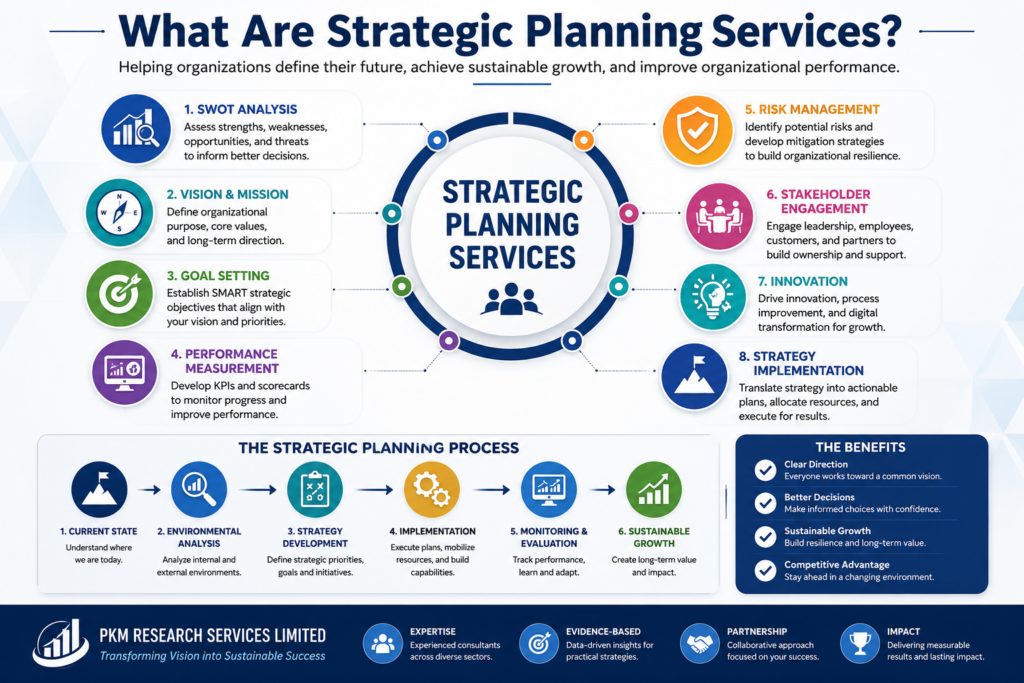
It refers to professional consulting and facilitation processes that help organizations define their vision, mission, long-term objectives, strategic priorities, implementation plans, and performance measurement systems.
These services typically include:
- Environmental scanning
- SWOT analysis
- PESTLE analysis
- Vision and mission development
- Strategic goal setting
- Risk assessment
- Performance measurement
- Strategy implementation planning
- Monitoring and evaluation
- Change management support
Professional consultants facilitate discussions that align leadership teams around common goals while ensuring that strategies remain practical and measurable.
Why Strategic Planning Services Are Essential for Sustainable Growth
1. Provides Clear Organizational Direction
Organizations without plans that are strategic often struggle with conflicting priorities.
It answers critical questions such as the following:
- Where are we today?
- Where do we want to be?
- How will we get there?
- How will success be measured?
When everyone understands the organization’s direction, employees become more focused, productive, and engaged.
Real-Life Example: Safaricom provides a compelling example of how strategic planning can drive sustainable growth.
Rather than remaining solely a mobile network operator, the company adopted a long-term strategy to diversify its services by investing in digital financial solutions, enterprise services, and innovation.
The launch and continuous expansion of M-PESA transformed mobile money in Kenya and beyond, while strategic investments in products such as Fuliza, M-Shwari, and digital business solutions strengthened customer loyalty and created new revenue streams.
By aligning its strategy with changing customer needs and technological advancements, Safaricom has maintained its market leadership and become one of East Africa’s most successful companies. This demonstrates how a well-executed strategic plan enables organizations to innovate, remain competitive, and achieve sustainable growth.
2. Improves Decision-Making
Organizations make hundreds of decisions every year. Without a strategic framework, these decisions often become reactive.
It helps leaders evaluate decisions based on long-term objectives rather than short-term pressures.
Benefits include:
- Better investment decisions
- Reduced operational risks
- Improved project prioritization
- Faster response to market changes
Every decision contributes toward achieving strategic objectives.
3. Enhances Resource Allocation
Resources are always limited.
Organizations must determine how to allocate the following:
- Financial resources
- Human resources
- Technology
- Time
- Infrastructure
A strategic plan ensures that resources support high-impact initiatives instead of being spread across competing priorities. For example, an organization planning digital transformation may prioritize technology investments over expanding physical offices because the digital capability is identified as a key growth driver.
Improves Organizational Agility
Today’s organizations face the following:
- Economic uncertainty
- Political instability
- Climate change
- Technological disruption
- Cybersecurity threats
- Changing customer expectations
Organizations with strategic plans adapt faster because they continuously monitor their external environment.
Rather than reacting to crises, they prepare contingency plans in advance. COVID-19 highlighted this reality. Organizations with digital transformation strategies quickly shifted to remote work and online service delivery, while many others struggled to survive.
4. Strengthens Competitive Advantage
Competitive advantage does not happen by accident. Organizations succeed because they intentionally differentiate themselves.
These services help organizations identify the following:
- Unique strengths
- Market opportunities
- Competitive threats
- Innovation opportunities
This enables businesses to position themselves effectively within their industries.
It supports innovation.
Innovation requires more than creative ideas.
Organizations need systems that encourage:
- Research and development
- Knowledge sharing
- Continuous improvement
- Technology adoption
It integrates innovation into organizational priorities.
Instead of treating innovation as occasional experimentation, organizations make it part of their long-term growth strategy.
5. Improves Employee Engagement
Employees perform better when they understand how their work contributes to organizational success.
It helps:
- Clarify responsibilities
- Align departmental objectives
- Improve communication
- Increase accountability
Organizations with engaged employees experience:
- Higher productivity
- Lower turnover
- Greater innovation
- Better customer satisfaction
Employees become partners in achieving organizational goals rather than simply completing assigned tasks.
6. Supports Financial Sustainability
Financial sustainability extends beyond increasing profits.
It involves creating long-term value while maintaining operational stability.
It therefore helps organizations:
- Diversify revenue streams
- Improve operational efficiency
- Reduce unnecessary costs
- Increase investment returns
- Manage financial risks
This creates a stronger foundation for sustainable growth.
It enhances risk management.
Every organization faces risks.
Examples include:
- Economic recessions
- Supply chain disruptions
- Regulatory changes
- Cyber attacks
- Natural disasters
Strategic planning incorporates risk management into decision-making.
Organizations identify potential threats before they become major problems.
Instead of asking:
“What happened?”
Strategic organizations ask: “What could happen, and how do we prepare?”
7. Improves Organizational Performance
Performance improves when objectives are measurable.
Strategic plans establish Key Performance Indicators (KPIs) such as the following:
- Revenue growth
- Customer satisfaction
- Employee retention
- Operational efficiency
- Market share
- Innovation metrics
Performance monitoring enables organizations to evaluate progress and adjust strategies when necessary.
The Strategic Planning Process
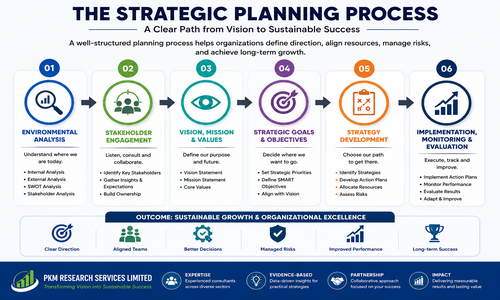
Step 1: Environmental Analysis
Evaluate internal strengths and weaknesses alongside external opportunities and threats.
Common tools include:
- SWOT Analysis
- PESTLE Analysis
- Competitor Analysis
Step 2: Vision and Mission Development
Organizations define:
- Purpose
- Core values
- Long-term aspirations
These statements guide strategic decision-making.
Step 3: Strategic Goal Setting
Goals should be:
- Specific
- Measurable
- Achievable
- Relevant
- Time-bound
Step 4: Strategy Formulation
Organizations identify initiatives needed to achieve strategic objectives.
Examples include:
- Market expansion
- Digital transformation
- Product innovation
- Customer experience improvement
Step 5: Implementation Planning
Implementation includes:
- Budget allocation
- Responsibility assignment
- Timelines
- Performance indicators
Step 6: Monitoring and Evaluation
Regular performance reviews ensure strategies remain relevant as business environments change.
Common Mistakes Organizations Make
Even organizations with strategic plans sometimes struggle because they:
- Create plans that are never implemented.
- Fail to involve employees in the planning process.
- Ignore changing market conditions.
- Set unrealistic objectives.
- Do not measure performance.
- Review the strategy only every five years.
Professional planning services help organizations avoid these common pitfalls by ensuring that plans are practical, actionable, and continuously monitored.
Real-Life Example: Equity Bank Kenya Limited
Equity Bank Kenya Limited demonstrates the value of strategic planning by expanding beyond traditional banking into digital financial services, agency banking, regional markets, and financial inclusion. Through innovations such as the Equity Mobile App and Equitel, coupled with investments in sustainability and community development, the bank has strengthened customer loyalty, improved operational efficiency, and achieved sustained growth. Its success illustrates how a clear strategic plan enables organizations to adapt to changing market needs and maintain a competitive advantage.
Its strategic initiatives include:
- Digital banking and mobile financial services
- Agency banking to increase financial inclusion
- Regional expansion across East and Central Africa
- Customer-centric product innovation
- Corporate social responsibility through the Equity Group Foundation
- Investment in employee development and leadership
These strategic initiatives strengthened customer loyalty while supporting sustainable business growth across global markets.
Why Organizations Should Invest in Strategic Planning Services
Many organizations attempt strategic planning internally.
While internal knowledge is valuable, external consultants provide the following:
- Objective perspectives
- Industry best practices
- Professional facilitation
- Data-driven insights
- Proven planning frameworks
Professional services help organizations produce strategies that are realistic, measurable, and aligned with evolving market conditions. The investment often pays for itself through improved efficiency, stronger governance, better risk management, and sustained competitive advantage.
Conclusion
Sustainable growth does not happen by chance; it is the result of intentional planning, disciplined execution, and continuous improvement. In an era marked by rapid technological change, shifting customer expectations, and increasing competition, organizations need more than ambition—they need a clear roadmap for the future.
A well-developed strategy empowers organizations to define their vision, align resources, manage risks, foster innovation, and measure progress effectively. From startups seeking market entry to established enterprises pursuing expansion, a comprehensive plan provides the foundation for resilience and long-term success. Organizations that invest in long-term planning are better positioned to anticipate change rather than react to it. They build stronger teams, make smarter decisions, and create lasting value for customers, employees, investors, and other stakeholders. Ultimately, effective strategy development is not merely a management exercise—it is a critical driver of sustainable growth and organizational excellence.
Why Choose PKM Research Services Limited for Strategic Planning Development?
At PKM Research Services Limited, we understand that a strategic plan is more than just a document—it is a roadmap that guides an organization’s growth, improves decision-making, and creates long-term value. We work closely with organizations to develop practical, results-oriented strategic plans that align with their vision, mission, and operating environment.
Our strategic planning process is collaborative and evidence-based, combining stakeholder engagement, industry best practices, and rigorous data analysis to produce strategies that are both actionable and measurable. Whether you are a private company, government agency, non-governmental organization (NGO), educational institution, or development partner, we tailor every strategic plan to your unique goals and challenges.
What Sets Us Apart?
- Experienced Strategy Consultants: Our team has extensive experience supporting organizations across diverse sectors, including public institutions, private enterprises, NGOs, educational institutions, and development organizations.
- Evidence-Based Planning: We use comprehensive situational analyses, including SWOT, PESTLE, stakeholder mapping, and performance assessments, to develop strategies grounded in reliable data.
- Participatory Approach: We engage leadership teams, employees, boards, and other key stakeholders throughout the planning process to ensure ownership and successful implementation.
- Customized Solutions: We recognize that every organization is unique. Our strategic plans are tailored to your industry, organizational culture, and long-term aspirations rather than relying on generic templates.
- Implementation-Focused: Beyond developing the strategic plan, we help organizations create implementation frameworks, performance indicators (KPIs), monitoring and evaluation systems, and risk management strategies to ensure successful execution.
- Capacity Building: We provide training and facilitation to equip leadership and staff with the skills needed to implement, monitor, and periodically review the strategic plan.
- Commitment to Sustainable Growth: Our strategic planning solutions integrate governance, innovation, digital transformation, sustainability, and organizational resilience to position your organization for long-term success.
Our Strategic Planning Services Include
- Strategic Plan Development
- Vision, Mission, and Core Values Review
- Environmental Scanning (SWOT, PESTLE, and Stakeholder Analysis)
- Strategic Goal and Objective Setting
- Strategy Implementation Frameworks
- Key Performance Indicators (KPIs) Development
- Monitoring, Evaluation, and Learning (MEL) Frameworks
- Risk Management and Business Continuity Planning
- Board and Management Strategy Retreat Facilitation
- Strategic Plan Review and Mid-Term Evaluation
Partner with PKM Research Services Limited
Whether your organization is developing its first strategic plan or reviewing an existing one, PKM Research Services Limited is your trusted partner in building a clear roadmap for sustainable growth. Our commitment to quality, professionalism, and client-centered solutions ensures that your organization is equipped with a practical strategy that delivers measurable results and lasting impact.
Ready to develop a winning strategy? Contact PKM Research Services Limited today and let us help your organization transform its vision into sustainable success.
Frequently Asked Questions (FAQs)
- What are strategic planning services?
Strategic planning services are professional consulting and facilitation services that help organizations develop long-term strategies, define goals, allocate resources effectively, and measure organizational performance. - Why is strategic planning important for business growth?
Strategic planning provides a clear roadmap for decision-making, improves resource utilization, enhances competitiveness, supports innovation, and helps organizations achieve sustainable long-term growth. - How often should an organization update its strategic plan?
Most organizations should review their strategic plans annually and conduct a comprehensive update every three to five years. However, rapidly changing industries may require more frequent reviews. - What industries benefit from strategic planning services?
Virtually every industry can benefit, including healthcare, education, manufacturing, financial services, government, nonprofits, technology, retail, hospitality, and energy. - What is included in a strategic planning process?
A typical strategic planning process includes environmental analysis, stakeholder consultation, vision and mission development, goal setting, strategy formulation, implementation planning, performance measurement, and ongoing monitoring and evaluation. - Can small businesses benefit from strategic planning services?
Yes. Small businesses often benefit significantly because strategic planning helps them prioritize limited resources, identify growth opportunities, manage risks, and compete more effectively with larger organizations. - What is the difference between strategic planning and business planning?
Strategic planning focuses on an organization’s long-term direction, priorities, and competitive positioning, while a business plan primarily outlines operational details, financial projections, and execution plans for a specific venture or period. - How do strategic planning services contribute to sustainable growth?
Strategic planning services support sustainable growth by aligning organizational objectives with available resources, improving decision-making, encouraging innovation, strengthening risk management, enhancing stakeholder engagement, and establishing measurable performance indicators that drive continuous improvement.