Table of Contents
Introduction
Every successful development project begins with a clear understanding of the situation before implementation. Whether an organization is working in education, healthcare, agriculture, climate resilience, governance, or livelihoods, making decisions without reliable evidence often leads to poor planning, inefficient resource allocation, and weak project outcomes. This is where baseline surveys become indispensable.
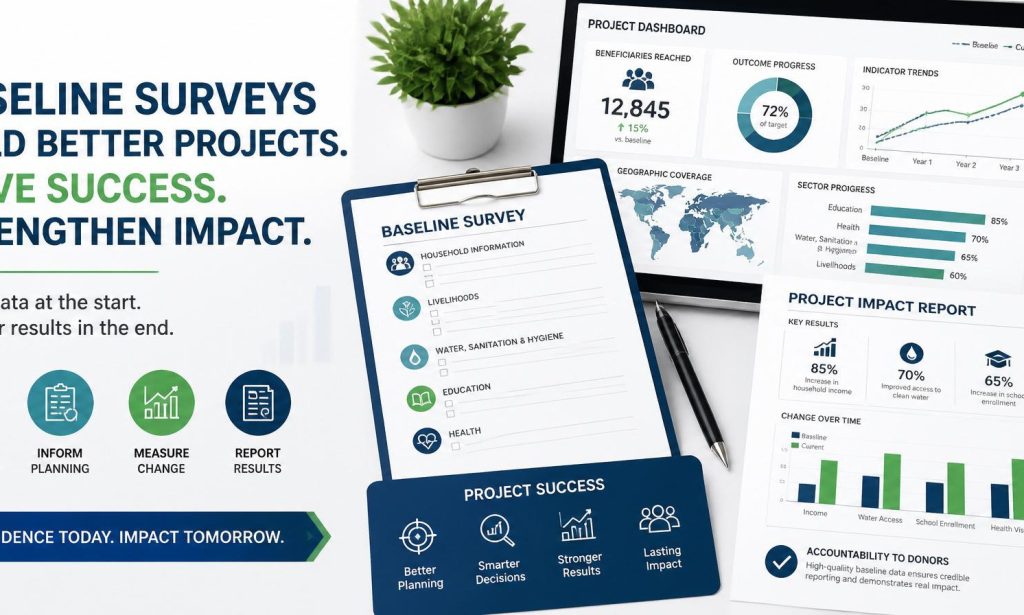
Baseline surveys provide the first comprehensive snapshot of existing conditions before project activities begin. They establish measurable benchmarks against which future progress can be assessed. Governments, NGOs, donor agencies, humanitarian organizations, research institutions, and private sector development programs rely on baseline studies to understand community needs, identify service gaps, design realistic interventions, and measure project impact.
In today’s competitive donor environment, organizations are increasingly expected to demonstrate measurable results rather than report completed activities. Donors such as USAID, the European Union, the World Bank, GIZ, UNICEF, UNDP, and many international foundations require evidence-based reporting supported by credible data. Without well-designed baseline surveys, organizations struggle to prove that their interventions actually created positive change.
Across Kenya and East Africa, organizations implementing projects in counties such as Turkana, Garissa, Kilifi, Busia, Kisumu, Kitui, Kakamega, and Narok increasingly invest in professional baseline studies because they recognize that quality data improves project planning, monitoring, evaluation, accountability, and learning.
This guide explains everything you need to know about baseline surveys, why they matter, how they improve project success, common mistakes to avoid, practical implementation steps, real-life examples from Kenya and East Africa, and best practices for producing donor-quality evidence.
What Are Baseline Surveys?
Baseline surveys are systematic studies conducted before project implementation to collect information about the current status of a target population, institution, community, or environment.
The purpose is to establish measurable indicators that serve as reference points throughout the project lifecycle.
For example:
- Household income levels
- School attendance rates
- Access to clean water
- Agricultural productivity
- Maternal healthcare utilization
- Youth employment rates
- Financial inclusion
- Community resilience
The collected information becomes the benchmark against which midline and endline evaluations compare project outcomes.
Without baseline data, it becomes extremely difficult to determine whether observed changes resulted from project interventions or other external factors.
Why Baseline Surveys Are Critical for Project Success
1. Baseline Surveys Improve Project Planning
Many projects fail because they are designed on assumptions rather than evidence.
A quality baseline helps organizations:
- Understand actual community needs
- Identify priority challenges
- Allocate resources effectively
- Design realistic interventions
- Set achievable objectives
2. Baseline Surveys Support Better Donor Reporting
Donors increasingly emphasize measurable impact rather than activity reporting.
Instead of saying
“We trained 500 farmers.”
Organizations can report:
“The percentage of farmers using climate-smart agriculture increased from 18% at baseline to 71% after project implementation.”
This evidence demonstrates genuine project outcomes.
Good donor reports answer questions such as:
- What changed?
- How much changed?
- Who benefited?
- Why did change occur?
- Was the intervention effective?
Reliable baseline data makes these questions easy to answer.
Baseline Surveys Help Establish SMART Indicators
Projects require indicators that are:
- Specific
- Measurable
- Achievable
- Relevant
- Time-bound
Baseline findings help determine realistic targets.
Example:
Before baseline:
Increase youth employment.
After baseline:
Increase formal employment among youth aged 18–35 from 32% to 50% within three years.
The second objective is measurable and easier to evaluate.
How Baseline Surveys Improve Monitoring and Evaluation (M&E)
Monitoring and evaluation depend heavily on quality baseline information.
Baseline data enables organizations to:
- Track project progress
- Compare planned versus actual results
- Identify implementation gaps
- Improve decision-making
- Measure long-term impact
- Demonstrate accountability
Without baseline information, organizations often rely on anecdotal evidence instead of measurable results.
Baseline Surveys Strengthen Evidence-Based Decision Making
Evidence-based decision-making minimizes guesswork.
Project managers can answer questions like the following:
- Which communities need urgent support?
- Which beneficiaries are most vulnerable?
- Which interventions provide the highest return?
- Where should resources be concentrated?
Quality baseline evidence reduces uncertainty throughout implementation.
Baseline Surveys Improve Risk Management
Projects face numerous risks, including
- Climate shocks
- Economic instability
- Political changes
- Disease outbreaks
- Migration
- Inflation
A baseline identifies existing vulnerabilities before implementation begins.
Risk mitigation strategies become easier because organizations understand the initial conditions.
How Baseline Surveys Improve Donor Confidence
Funding organizations want assurance that resources are producing measurable outcomes.
A professionally conducted baseline demonstrates:
- Organizational credibility
- Technical competence
- Accountability
- Transparency
- Strong monitoring systems
Organizations with robust baseline systems often produce stronger funding proposals because they present credible evidence supporting project needs.
Key Components of High-Quality Baseline Surveys
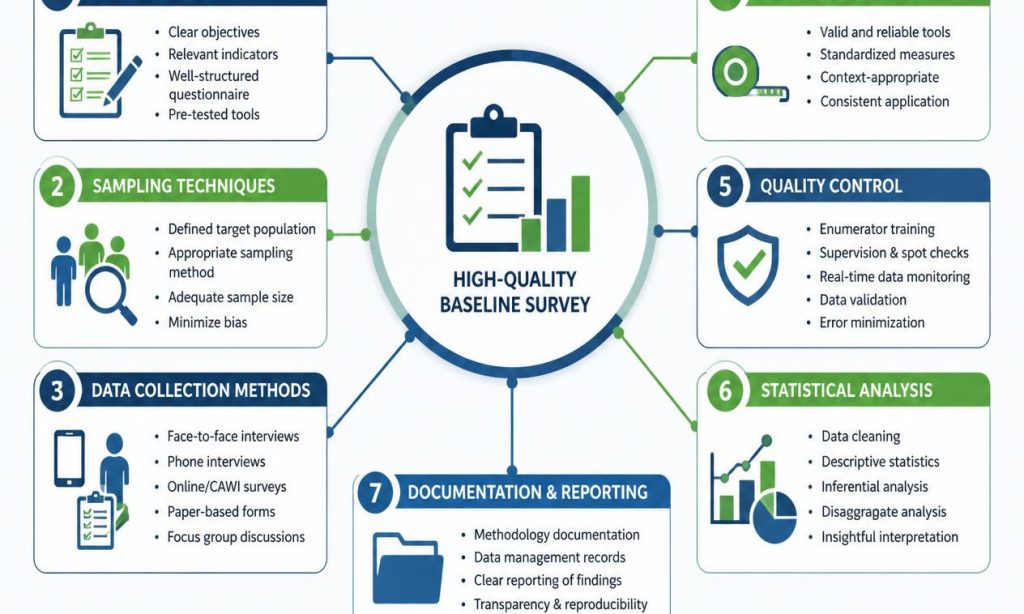
Successful baseline surveys typically include the following components:
Project Context
A clear description of:
- Problem statement
- Geographic coverage
- Target beneficiaries
- Stakeholders
- Project objectives
Survey Objectives
Objectives define exactly what the study intends to measure.
Indicators
Examples include:
- Household income
- School enrollment
- Agricultural yield
- Water access
- Employment
- Nutrition status
Sampling Design
Scientific sampling ensures findings represent the target population.
Common methods include:
- Random sampling
- Stratified sampling
- Cluster sampling
- Systematic sampling
Data Collection Tools
These may include:
- Household questionnaires
- Key informant interviews
- Focus group discussions
- Observation checklists
- Mobile data collection platforms
Data Analysis
Analysis transforms raw information into actionable insights using statistical software such as SPSS, STATA, R, or Power BI.
Baseline Report
The final report summarizes findings, recommendations, and indicator benchmarks.
Real-Life Example: Water and Sanitation Project in Kenya
A humanitarian organization implemented a WASH project in arid counties affected by recurrent drought.
The baseline surveys identified the following:
- Long distances to water points
- High prevalence of waterborne diseases
- Low household latrine coverage
- Limited hygiene awareness
The project invested in boreholes, sanitation facilities, hygiene promotion campaigns, and community water management committees.
Subsequent monitoring indicated increased access to safe water, improved sanitation practices, and a reduction in reported water-related illnesses. Baseline benchmarks enabled accurate measurement of these improvements and strengthened donor reporting.
Common Mistakes Organizations Make During Baseline Surveys
Even experienced organizations sometimes make avoidable errors.
These include:
Conducting Surveys Too Late
Baseline studies should occur before implementation begins.
Measuring Too Many Indicators
Collect only indicators linked directly to project objectives.
Poor Sampling
Small or biased samples produce unreliable findings.
Weak Enumerator Training
Poorly trained field teams collect inconsistent data.
Ignoring Data Quality
Data verification should occur throughout fieldwork.
Poor Documentation
Methodology should be transparent enough for replication.
Best Practices for Conducting Baseline Surveys
Organizations should:
- Define clear objectives.
- Develop a robust sampling strategy.
- Use digital data collection tools where possible.
- Pilot-test questionnaires.
- Train enumerators thoroughly.
- Supervise fieldwork closely.
- Validate and clean data before analysis.
- Use both quantitative and qualitative methods where appropriate.
- Engage community stakeholders.
- Produce clear, actionable reports.
These practices improve the credibility and usefulness of survey findings.
Digital Tools for Baseline Surveys
Technology has significantly improved data collection and analysis.
Common tools include:
- KoboToolbox
- SurveyCTO
- Open Data Kit (ODK)
- CommCare
- Microsoft Power BI
- Tableau
- SPSS
- STATA
- R
Digital platforms reduce data entry errors, improve accuracy, and enable real-time monitoring of field activities.
The Link Between Baseline Surveys and Project Sustainability
Sustainable projects require continuous learning.
Baseline findings help organizations:
- Design context-specific interventions.
- Monitor long-term progress.
- Adapt implementation strategies.
- Build community ownership.
- Strengthen institutional learning.
Organizations that invest in quality baseline studies are better positioned to scale successful interventions and secure future funding.
How Baseline Surveys Strengthen Proposal Development
Baseline evidence also enhances funding proposals by:
- Demonstrating a clearly defined problem.
- Providing credible statistics.
- Justifying resource allocation.
- Establishing measurable targets.
- Showing organizational capacity for evidence-based programming.
Many successful grant applications include baseline findings or reference previous baseline studies to support the proposed intervention.
Conclusion
Successful projects are built on reliable evidence rather than assumptions. Baseline surveys provide that evidence by establishing a clear picture of existing conditions before project implementation begins. They improve project design, strengthen monitoring and evaluation systems, support adaptive management, and enable organizations to report meaningful, measurable outcomes to donors.
Across Kenya and East Africa, organizations implementing development, humanitarian, governance, health, education, agriculture, and climate resilience initiatives are increasingly recognizing the value of investing in high-quality baseline surveys. These studies not only improve accountability and transparency but also help ensure that scarce resources are directed toward interventions that address genuine community needs.
As donor expectations continue to evolve toward evidence-based programming and results-oriented management, organizations that prioritize rigorous baseline studies will be better positioned to demonstrate impact, build credibility, secure future funding, and achieve sustainable development outcomes. Whether you are launching a new project or strengthening an existing monitoring and evaluation framework, investing in a professionally designed baseline survey is one of the most effective steps you can take toward long-term project success and stronger donor reporting.
Why Choose PKM Research Services Limited for Baseline Surveys?
Conducting a high-quality baseline survey requires more than just collecting data—it demands sound research design, methodological rigor, advanced data analysis, and practical recommendations that support evidence-based decision-making. At PKM Research Services Limited, we provide comprehensive baseline survey solutions that help organizations generate reliable data for project planning, monitoring and evaluation (M&E), impact assessment, and donor reporting.
Our experienced team of researchers, statisticians, monitoring and evaluation specialists, and data analysts works closely with NGOs, government agencies, development partners, private sector organizations, academic institutions, and international organizations to deliver baseline studies that meet global research standards. We apply scientifically sound sampling techniques, develop customized data collection tools, and utilize modern digital platforms such as KoboToolbox, ODK, SurveyCTO, and CommCare to ensure efficient, accurate, and high-quality data collection.
Our baseline survey services include the following:
- Project-specific baseline survey design and methodology development
- Questionnaire and data collection tool development
- Scientific sampling design and sample size determination
- Digital data collection using mobile-based platforms
- Enumerator recruitment, training, and field supervision
- Quantitative and qualitative data analysis
- Statistical analysis using SPSS, STATA, R, and Excel
- GIS mapping and data visualization where required
- Comprehensive baseline survey report writing
- Development of monitoring and evaluation indicators
- Presentation of findings to project teams and stakeholders
Why Organizations Trust PKM Research Services Limited
- Experienced Research Professionals: Our multidisciplinary team has extensive experience conducting baseline surveys across sectors, including agriculture, health, education, governance, livelihoods, environmental conservation, water and sanitation, gender, and private sector development.
- High-Quality Data: We employ rigorous quality assurance procedures throughout the research process to ensure the accuracy, reliability, and validity of collected data.
- Customized Research Solutions: Every project is unique. We tailor our survey methodologies and data collection approaches to align with your project objectives, donor requirements, and operating context.
- Advanced Data Analytics: We transform raw data into actionable insights through robust statistical analysis, clear visualizations, and practical recommendations that inform strategic decision-making.
- Donor-Compliant Reporting: Our reports are prepared to meet the standards and reporting expectations of international donors, development partners, and funding agencies, ensuring that your organization can confidently demonstrate project needs and measure future impact.
- Timely Project Delivery: We understand the importance of project timelines and are committed to delivering high-quality baseline survey reports within agreed schedules without compromising quality.
- Ethical and Confidential Research Practices: We uphold the highest standards of research ethics, including informed consent, data confidentiality, and compliance with national and international research guidelines.
Partner with PKM Research Services Limited
Whether you are launching a new development project, preparing a donor-funded program, or strengthening your monitoring and evaluation framework, PKM Research Services Limited is your trusted partner for professional baseline surveys. Our evidence-driven approach ensures that your project starts with accurate baseline data, enabling better planning, stronger donor reporting, and measurable, lasting impact.
Contact us today to discuss your baseline survey needs and discover how our research expertise can help your organization design more effective projects, demonstrate results with confidence, and maximize development impact.
Frequently Asked Questions (FAQs)
- What are Baseline Surveys?
Baseline surveys are studies conducted before a project starts to establish benchmark data against which future progress and project impact can be measured. - Why are baseline surveys important?
They provide reliable evidence for project planning, monitoring, evaluation, learning, accountability, and donor reporting. - Who should conduct baseline surveys?
They are typically conducted by monitoring and evaluation specialists, research consultants, universities, NGOs, consulting firms, or experienced project staff with expertise in survey design and data analysis. - When should baseline surveys be conducted?
They should be completed before project implementation begins and before beneficiaries receive any intervention. - What is the difference between a baseline and an endline survey?
A baseline survey measures conditions before implementation, while an endline survey measures conditions after project completion to determine the extent of change. - Can small organizations conduct baseline surveys?
Yes. Even small NGOs and community-based organizations can conduct well-designed baseline studies using appropriate sampling methods, digital data collection tools, and sound quality assurance procedures. - Which sectors benefit from baseline surveys?
Baseline surveys are valuable across many sectors, including health, education, agriculture, governance, livelihoods, water and sanitation, environmental conservation, humanitarian response, gender programs, and private sector development. - How do baseline surveys improve donor reporting?
They provide measurable benchmark data that allows organizations to compare pre-project and post-project conditions, making it easier to demonstrate outcomes, impact, and value for money.