In today’s data-driven economy, organizations generate enormous amounts of information every day from customer transactions and financial records to employee performance reports and market trends. However, collecting data alone is not enough. The real value lies in analyzing that data to uncover insights that support better decision-making. This is exactly How Data Analytics Helps Organizations succeed in an increasingly competitive business environment.
Whether you are a small business owner, a government institution, an NGO, or a multinational corporation, data analytics enables you to move beyond assumptions and make decisions based on evidence. Organizations that leverage data effectively can identify new opportunities, improve operational efficiency, understand customer behavior, manage risks, and achieve sustainable growth.
At PKM Research Services Limited, we help organizations transform raw data into actionable insights through advanced data analytics, business intelligence, statistical modelling, dashboard development, Geographic Information Systems (GIS), predictive analytics, and decision support systems. Our evidence-based approach empowers organizations to make informed strategic decisions that improve performance and deliver measurable results.
In this guide, we’ll explore How Data Analytics Helps Organizations make better business decisions, improve performance, and stay ahead in today’s rapidly evolving marketplace.
Table of Contents
How Data Analytics Helps Organizations: Understanding Data Analytics
Before exploring How Data Analytics Helps Organizations, it’s important to understand what data analytics actually means.
Data analytics is the process of collecting, organizing, cleaning, analyzing, and interpreting data to identify patterns, trends, and insights that support informed decision-making. Rather than relying on intuition or guesswork, organizations use analytical tools and techniques to answer critical business questions with confidence.
Modern data analytics combines statistical methods, visualization tools, and digital technologies to transform complex datasets into meaningful information that decision-makers can easily understand.
Common sources of organizational data include:
- Sales and financial records
- Customer feedback and satisfaction surveys
- Employee performance data
- Supply chain and procurement information
- Marketing campaign performance
- Market research findings
- Monitoring and evaluation (M&E) reports
- Operational and production data
At PKM Research Services Limited, data analytics services include data management systems, dashboard development, business intelligence, statistical modelling, GIS, predictive analytics, data quality audits, research automation, and decision support systems to help organizations convert data into strategic insights.
Why How Data Analytics Helps Organizations Matters in Today’s Business Environment
Organizations today operate in highly competitive and rapidly changing environments. Consumer preferences shift quickly, technologies evolve, regulations change, and economic conditions fluctuate. Businesses that rely solely on experience or instinct often struggle to respond effectively to these changes.
This is where understanding How Data Analytics Helps Organizations becomes essential.
Better Visibility into Business Performance
Data analytics provides leaders with a clear picture of how their organizations are performing.
Instead of relying on monthly summaries or assumptions, managers can monitor key performance indicators (KPIs) in real time, allowing them to identify issues early and make timely adjustments.
For example, a retail company can use sales dashboards to identify which products perform best, which branches generate the highest revenue, and which customer segments contribute most to overall profitability.
Improved Customer Understanding
Every interaction with customers generates valuable information.
Organizations can analyze customer data to understand:
- Purchasing behavior
- Customer preferences
- Service expectations
- Seasonal buying trends
- Customer satisfaction levels
These insights help businesses improve products, personalize services, and strengthen customer relationships.
Real-life example:
A supermarket chain in Kenya noticed declining sales in one of its outlets despite stable customer traffic. By analyzing sales data, management discovered that essential household products were frequently out of stock during peak shopping hours. After adjusting inventory management based on data insights, product availability improved, customer satisfaction increased, and sales recovered significantly.
Faster Response to Market Changes
Market conditions change rapidly.
Organizations using data analytics can quickly detect:
- Emerging customer needs
- New competitors
- Changing consumer behavior
- Economic trends
- Industry opportunities
Rather than reacting after problems occur, organizations can anticipate changes and make proactive business decisions.
How Data Analytics Helps Organizations Improve Decision-Making
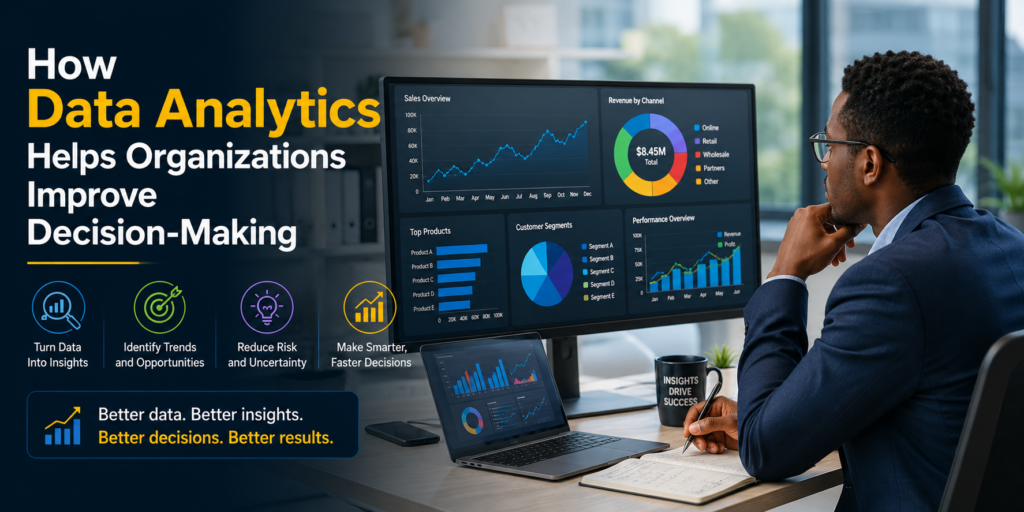
The greatest advantage of data analytics is its ability to support informed decision-making. Leaders who have access to accurate and timely information are better equipped to allocate resources, evaluate risks, and plan for the future.
Evidence-Based Decisions
One of the clearest examples of How Data Analytics Helps Organizations is by replacing assumptions with evidence.
Instead of asking:
“What do we think customers want?”
Organizations can ask:
“What does our customer data tell us?”
This shift leads to more accurate decisions that are supported by measurable facts rather than opinions.
Identifying Growth Opportunities
Data analytics helps organizations identify opportunities that may otherwise go unnoticed.
Businesses can analyze:
- Customer demand
- Geographic markets
- Product performance
- Sales trends
- Marketing effectiveness
These insights help leaders determine where to invest resources for maximum returns.
For instance, a manufacturing company may discover through sales analysis that demand for one product category is increasing in a specific region. The company can then allocate additional inventory, expand distribution channels, or introduce targeted marketing campaigns in that market.
Improving Operational Efficiency
Every organization seeks to reduce costs while increasing productivity.
Data analytics identifies inefficiencies by revealing:
- Process bottlenecks
- Resource wastage
- Delays in service delivery
- Underperforming departments
- Excess operational costs
With this information, management can implement targeted improvements that enhance efficiency and profitability.
Real-life example:
A logistics company analyzed GPS tracking data from its delivery vehicles and found that certain routes consistently caused delays and increased fuel consumption. By redesigning delivery schedules and optimizing routes using data insights, the company reduced transportation costs, shortened delivery times, and improved customer satisfaction.
How Data Analytics Helps Organizations Across Different Sectors
One of the greatest strengths of data analytics is its versatility. Regardless of industry, organizations generate data that can be transformed into actionable insights. Understanding How Data Analytics Helps Organizations across different sectors demonstrates why data-driven decision-making has become essential for long-term success.
SMEs and Private Businesses
Small and medium-sized enterprises (SMEs) often operate with limited resources, making every business decision critical. Data analytics enables SMEs to maximize efficiency and profitability by providing insights into:
- Customer purchasing behavior
- Sales performance
- Inventory management
- Marketing effectiveness
- Cash flow trends
- Product profitability
For example, an SME can analyze sales data to identify its best-selling products and focus marketing efforts on high-performing product lines while reducing investment in slow-moving inventory.
Government Institutions
Government agencies collect large volumes of administrative and socio-economic data. By applying data analytics, public institutions can:
- Improve service delivery
- Allocate resources more efficiently
- Monitor programme performance
- Support evidence-based policy development
- Enhance accountability and transparency
Data-driven governance enables better planning and more effective use of public resources, ultimately improving service delivery to citizens.
NGOs and Development Organizations
Development organizations rely heavily on data to demonstrate project impact and accountability to donors.
Through data analytics, NGOs can:
- Monitor project progress
- Measure programme outcomes
- Identify implementation challenges
- Improve beneficiary targeting
- Produce high-quality donor reports
- Support evidence-based learning
Organizations that integrate analytics into their Monitoring, Evaluation, and Learning (MEL) systems are better positioned to improve programme effectiveness and demonstrate measurable impact.
Healthcare Organizations
Healthcare providers use analytics to improve patient outcomes and operational efficiency.
Applications include:
- Disease surveillance
- Resource allocation
- Patient flow management
- Health programme evaluation
- Predicting healthcare demand
- Monitoring service quality
These insights enable healthcare organizations to make timely decisions that improve both patient care and organizational performance.
The Role of Predictive Analytics and Business Intelligence
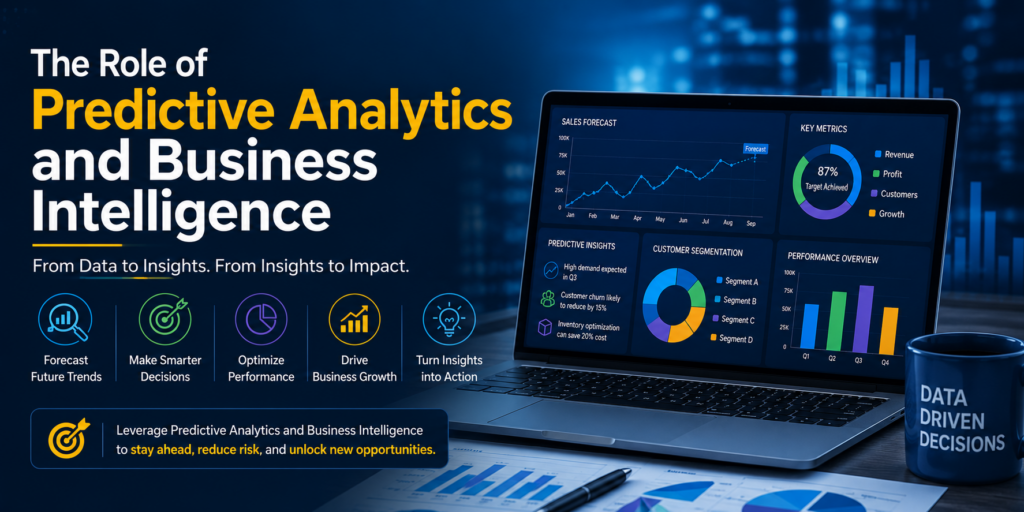
Understanding How Data Analytics Helps Organizations goes beyond analyzing past performance. Modern analytics enables organizations to anticipate future trends and respond proactively through predictive analytics and business intelligence.
Predictive Analytics
Predictive analytics uses historical data, statistical models, and machine learning techniques to forecast future outcomes.
Organizations use predictive analytics to:
- Forecast customer demand
- Predict sales trends
- Estimate project risks
- Identify equipment maintenance needs
- Improve financial planning
- Optimize inventory levels
Instead of reacting to problems after they occur, organizations can prepare for future challenges and opportunities.
Real-life example:
A distributor of agricultural inputs analyzed historical sales data alongside seasonal weather patterns to predict demand for fertilizer across different counties. By stocking products based on these forecasts, the company reduced stock shortages during peak planting seasons and improved customer satisfaction while minimizing excess inventory.
Business Intelligence
Business Intelligence (BI) transforms raw organizational data into interactive dashboards and reports that support strategic decision-making.
Business intelligence solutions help managers:
- Monitor key performance indicators (KPIs)
- Compare departmental performance
- Track financial results
- Identify emerging trends
- Make faster management decisions
Rather than reviewing multiple spreadsheets, executives can access real-time dashboards that provide an overview of organizational performance.
PKM Research Services Limited offers business intelligence solutions, dashboard development, statistical modelling, Geographic Information Systems (GIS), predictive analytics, data management systems, and decision support systems that enable organizations to transform complex datasets into actionable business insights.
Why Choose PKM Research Services Limited for Data Analytics Solutions?
Choosing the right data analytics partner is just as important as selecting the right technology. Organizations need advisors who not only understand data but also know how to translate analytical findings into practical business solutions.
PKM Research Services Limited provides integrated data analytics and digital solutions that help organizations improve decision-making, strengthen operational performance, and achieve sustainable growth. By combining technical expertise with evidence-based methodologies, the firm supports organizations across the public, private, and development sectors.
Comprehensive Data Analytics Services
Our data analytics solutions include:
- Data Management Systems
- Dashboard Development
- Business Intelligence
- Geographic Information Systems (GIS)
- Statistical Modelling
- Predictive Analytics
- Data Quality Audits
- Digital Survey Platforms
- Research Automation
- Decision Support Systems
These services enable organizations to collect, analyze, visualize, and interpret data for more effective decision-making.
Evidence-Based Decision Support
At PKM Research Services Limited, we believe that every strategic decision should be supported by credible evidence. Our multidisciplinary team combines research expertise, advanced analytics, and industry experience to deliver practical recommendations that address real organizational challenges.
Experienced Analytics Professionals
Our team includes experienced specialists in research, monitoring and evaluation, statistics, data analytics, and business intelligence. This expertise enables us to manage complex datasets, conduct advanced statistical analysis, and generate insights that support organizational transformation.
Customized Analytics Solutions
Every organization has unique information needs. We design tailored analytics solutions that align with each client’s objectives, helping them improve performance, strengthen accountability, and make confident, evidence-based decisions.
Frequently Asked Questions (FAQs)
1. How Data Analytics Helps Organizations improve decision-making?
Data analytics enables organizations to analyze historical and real-time data, identify trends, evaluate performance, predict future outcomes, and make informed decisions based on evidence rather than assumptions.
2. What types of organizations benefit from data analytics?
Businesses, SMEs, government agencies, NGOs, healthcare organizations, educational institutions, financial institutions, and development partners can all benefit from data analytics.
3. What is the difference between data analytics and business intelligence?
Data analytics focuses on examining data to identify insights and trends, while business intelligence presents those insights through dashboards, reports, and visualizations that support day-to-day management decisions.
4. How can data analytics improve organizational performance?
Data analytics helps organizations optimize operations, reduce costs, improve customer satisfaction, strengthen risk management, monitor performance, and identify new business opportunities.
5. What data analytics services does PKM Research Services Limited offer?
PKM Research Services Limited provides data management systems, dashboard development, business intelligence, GIS, statistical modelling, predictive analytics, data quality audits, digital survey platforms, research automation, and decision support systems.
6. Why should organizations invest in data analytics?
Organizations that invest in data analytics make better strategic decisions, improve operational efficiency, strengthen accountability, enhance competitiveness, and position themselves for sustainable growth.
Conclusion
Understanding How Data Analytics Helps Organizations is no longer optional in today’s digital economy. Organizations that embrace data-driven decision-making are better equipped to identify opportunities, respond to market changes, improve operational efficiency, manage risks, and achieve long-term success.
Whether through business intelligence dashboards, predictive analytics, statistical modelling, or data quality management, analytics transforms raw information into meaningful insights that guide smarter decisions. For businesses, government agencies, NGOs, and development organizations, investing in data analytics is an investment in better performance, innovation, and sustainable growth.
At PKM Research Services Limited, we are committed to helping organizations unlock the full value of their data through practical, evidence-based analytics solutions. Our expertise in data management, business intelligence, predictive analytics, GIS, statistical modelling, and decision support systems enables clients to make confident decisions backed by reliable evidence and actionable insights.
Ready to transform your data into smarter business decisions? Contact PKM Research Services Limited today to discover how our data analytics solutions can help your organization improve performance, strengthen decision-making, and achieve sustainable growth through evidence-based insights.